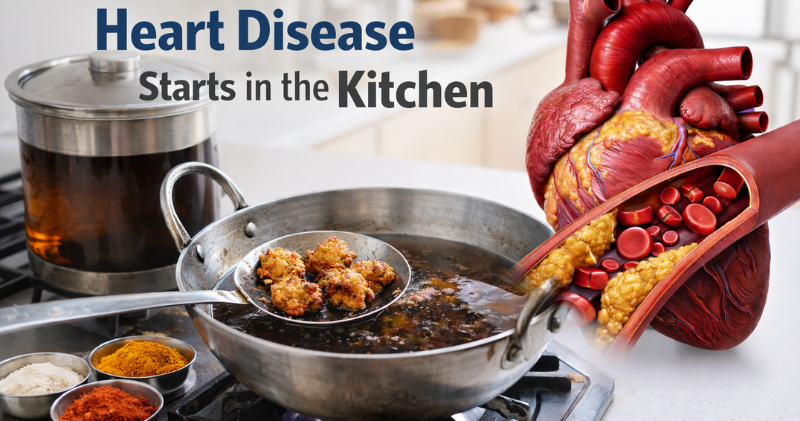
There is a small vessel near your stove. Maybe it is a steel bowl with a lid. Maybe it is the same pot you fried last night’s onion bhaji in, sitting covered with a cloth. Inside is yesterday’s oil — strained, filtered, ready to use again tomorrow. Your mother kept one. Your grandmother kept one. You probably keep one too.
This is not a sign of waste or carelessness. It is a tradition rooted in frugality and the belief that filtered oil is perfectly clean. For generations, it has felt like the smart, sensible thing to do.
But here is what your kitchen cannot show you: something invisible is happening to that oil every time you heat it. And if you are South Asian, (Indian, Pakistani, Sri Lankan, et al), that invisible change matters more for your heart than it does for almost anyone else.
What Heat Does to Oil — In Simple Words
When you heat oil, especially to the high temperatures used in Indian cooking — deep frying, tempering, making tadka — the oil goes through a chemical change called lipid oxidation.
Think of it this way: fresh oil is like a clean river. When you heat it once, small amounts of harmful particles form in the water. When you heat it again, more particles form. By the third or fourth time, the water looks clear to your eyes, but it is full of things you cannot see.
Those invisible things are called aldehydes, acrolein, and oxidized lipids. They are not removed by filtering. Filtering only takes out food particles — the bits of batter, the specks of spice. Filtering does not remove the molecular damage that has already happened to the oil itself.
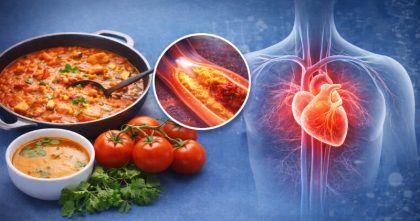
Once those oxidized lipids enter your body, they trigger inflammation in your blood vessels. They damage the inner lining of your arteries. They contribute directly to the buildup of fatty plaques — a process called atherosclerosis, which is the root cause of most heart attacks and strokes. This has been documented in peer-reviewed research on oxidized lipids and cardiovascular disease.
Why This Is Especially Important for South Asians
South Asians — people from India, Pakistan, Bangladesh, Sri Lanka, and Nepal — develop heart disease at higher rates than almost any other ethnic group in the world. Heart attacks happen earlier, sometimes 10 years younger than in white European populations. And when they happen, they are often more severe.
The reasons are partly genetic. South Asians tend to carry more visceral fat — fat stored around internal organs — even when they look thin. They often have lower HDL (the “good” cholesterol) and higher levels of a particle called Lp(a) that increases clotting risk.
These are not things you can change. But the food you cook every day — and the oil you cook it in — is something you can change. Adding reused, oxidized oil to an already elevated baseline risk is like adding fuel to a fire that is already burning.
Fresh vs. Reused: What Changes in Your Oil
Here is a comparison of common South Asian cooking oils — fresh versus repeatedly heated. One finding may surprise you.
| Oil Type | Smoke Point (Fresh) | Stability Under Reheating | Risk When Reused | Recommended Use |
|---|---|---|---|---|
| Ghee (fresh) | ~485°F / 252°C | HIGH — very stable | Low — most stable South Asian fat | Best choice for high-heat cooking |
| Ghee (reused 3x+) | Drops significantly | Breaks down over time | Moderate — still safer than refined oils | Replace more often than refined oils |
| Coconut oil (fresh) | ~350°F / 177°C | HIGH — saturated fats resist oxidation | Low when used correctly | Good for medium-heat cooking |
| Coconut oil (reused) | Drops noticeably | Moderate | Moderate — watch for darkening or odor | Discard after 2–3 uses |
| Sunflower / vegetable oil (fresh) | ~440°F / 227°C | LOW — high in polyunsaturated fats | High — degrades quickly | Use once for high heat; limit reuse |
| Sunflower / vegetable oil (reused 2x+) | Drops sharply | VERY LOW | Very High — produces most oxidized lipids | Discard after one use at high heat |
Key finding: Ghee and coconut oil are more stable under repeated heating than refined vegetable oils.
This does not mean you can reuse them without limits — but it does mean that your traditional cooking fats may be safer than the “healthy” refined oils marketed to you.
What You Can Do — Without Changing Your Food
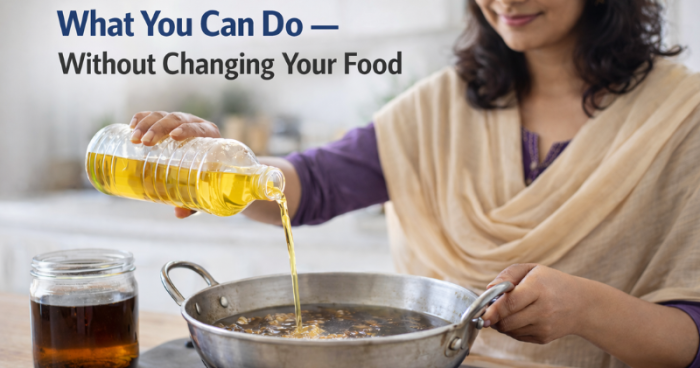
This article is not asking you to stop cooking South Asian food. The biryani stays. The dal stays. The pakoras stay.
These are small, practical changes that make a real difference:
Use smaller amounts of oil each time.Instead of filling the kadai, use just enough. Less oil means less to oxidize and less exposure overall.
Replace your oil more often.If you are reusing oil from a deep fry, consider replacing it after one or two uses rather than five or six. The cost of fresh oil is small. The cost of arterial inflammation is not.
Watch for signs of degradation.Oil that has gone dark, smells different, or smokes at lower temperatures than usual has already degraded significantly. Discard it.
Choose your oil based on your cooking method. For high-heat cooking (frying, tempering), ghee or refined coconut oil are more stable choices than sunflower or vegetable oil. For lower heat (sautéing), any fresh oil is fine.
Never mix old oil with fresh oil.Adding fresh oil to a container of old oil does not restore it. The oxidized compounds remain active.
Know Your Own Risk
Reused oil is one variable among many that shapes your cardiovascular future. But it is one of the few variables you can change starting today, in your kitchen, without a doctor’s appointment or a prescription.
The bigger picture is your personal cardiovascular risk — and that depends on factors specific to you: your age, your family history, your blood pressure, your cholesterol, your weight, your activity level, and yes, your diet.
The SACRA Calculator (South Asian Cardiovascular Risk Assessment) was built specifically for South Asian populations, incorporating the unique risk factors that standard Western tools miss. It is free, it takes less than five minutes, and it was designed by clinicians who understand South Asian cardiovascular biology.
Find out your personal cardiovascular risk. Take the free SACRA assessment at SouthAsianHeart.com →